
Your calendar, on your own server.
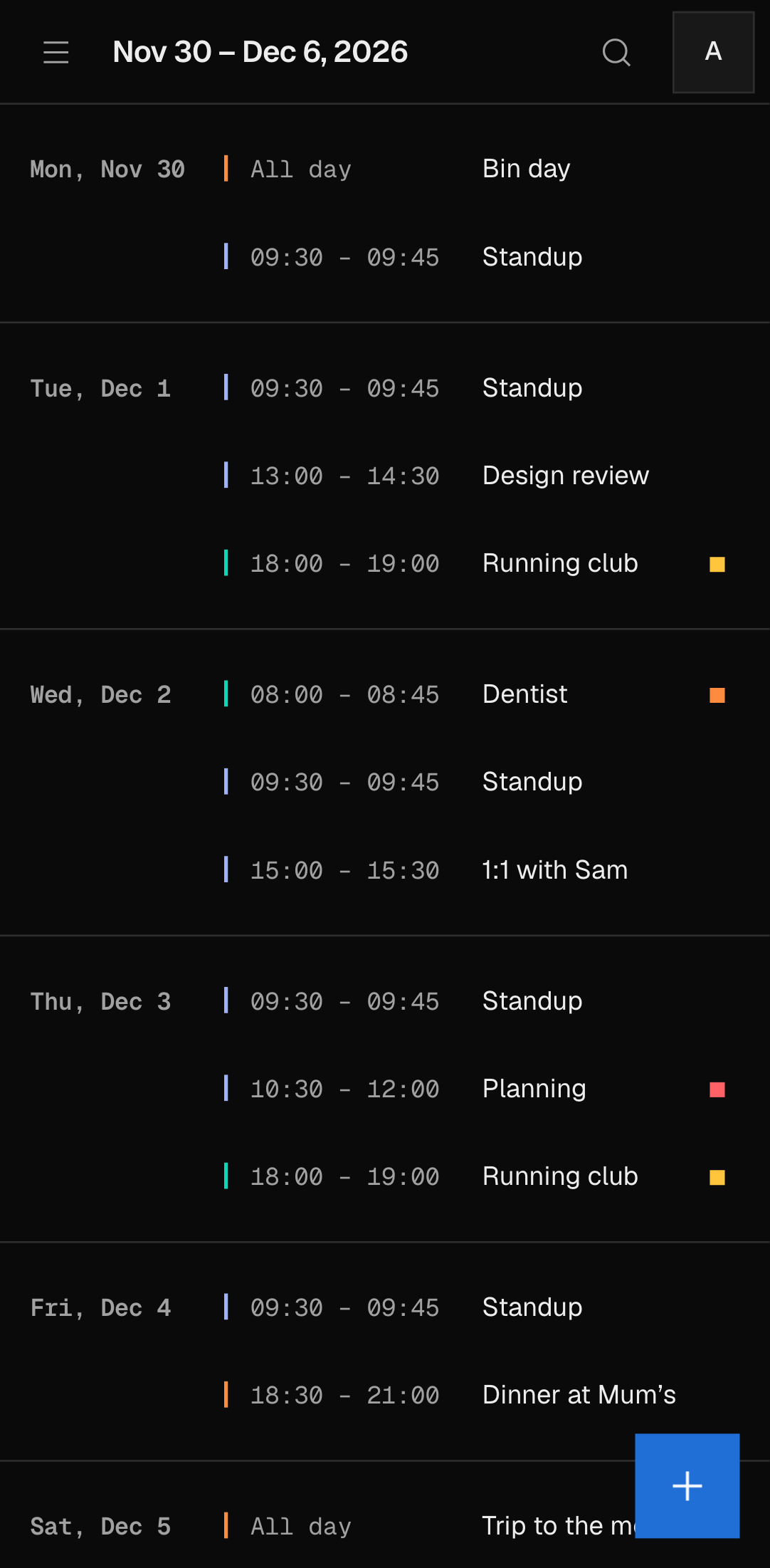
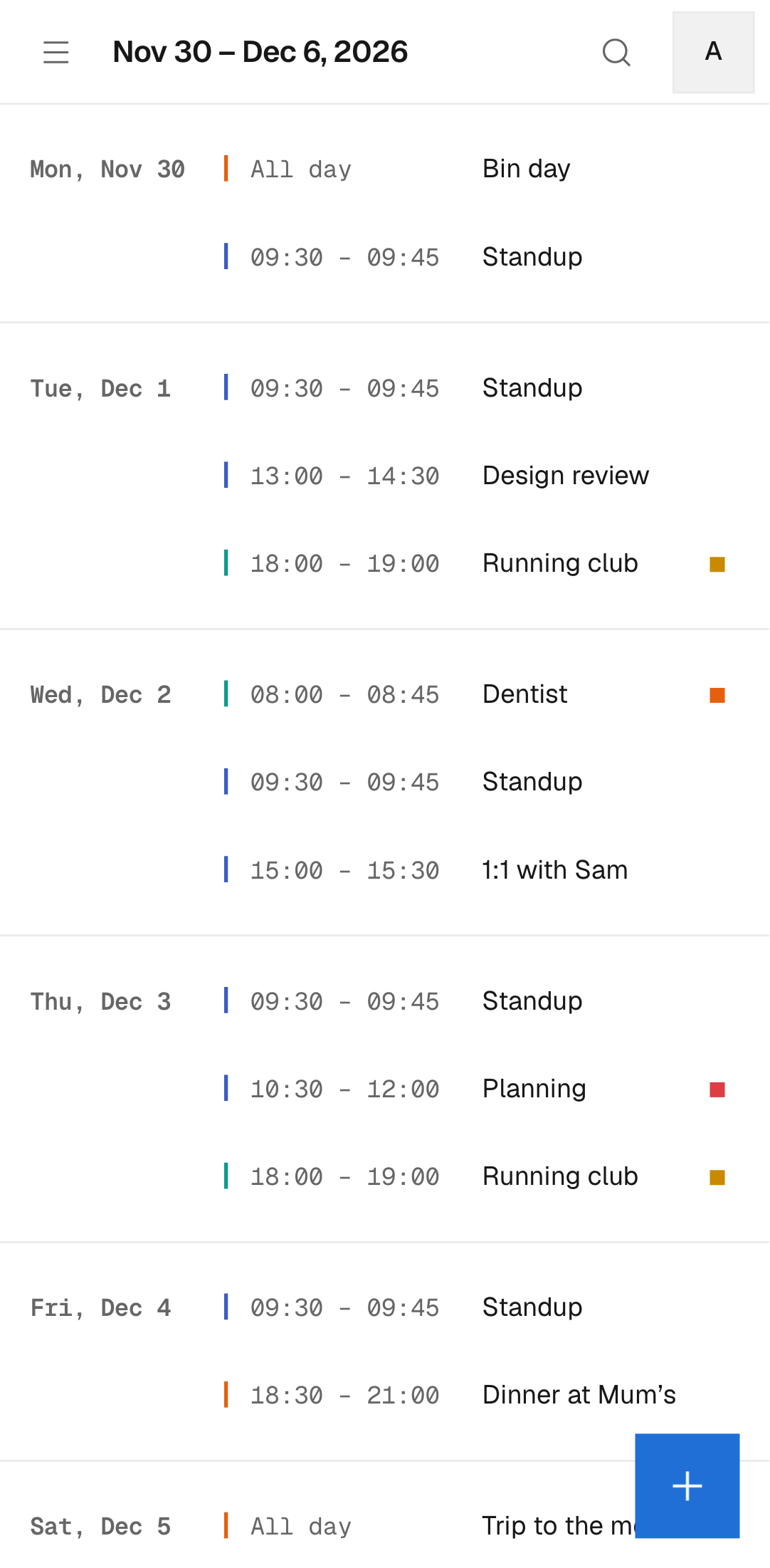
Month, week, day and agenda views, events that repeat the way your weeks do, and reminders on your phone or in your inbox. Install it on your phone like an app; your plans stay on your server.
Version 0.3.0, free and open source
What it does
-
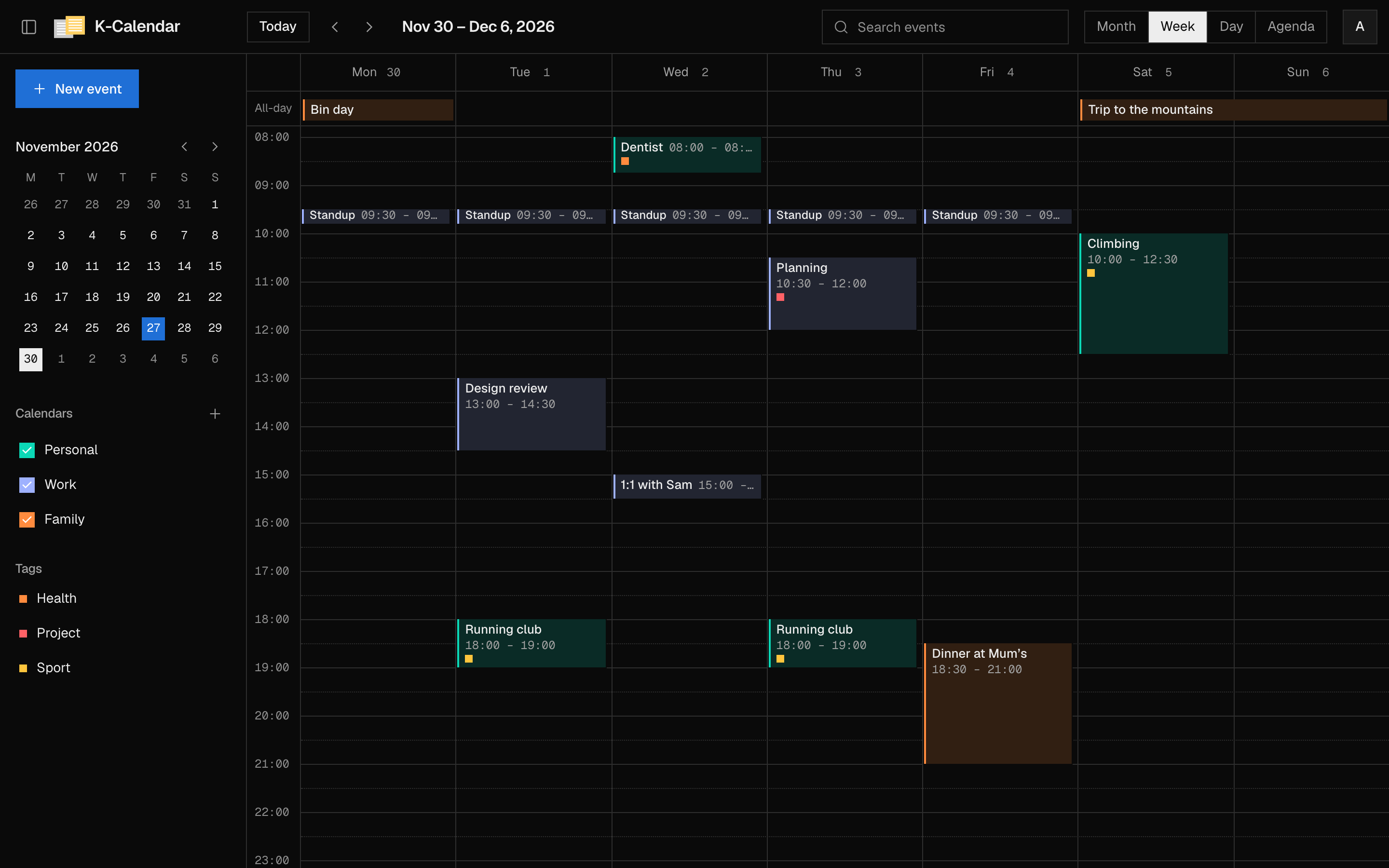
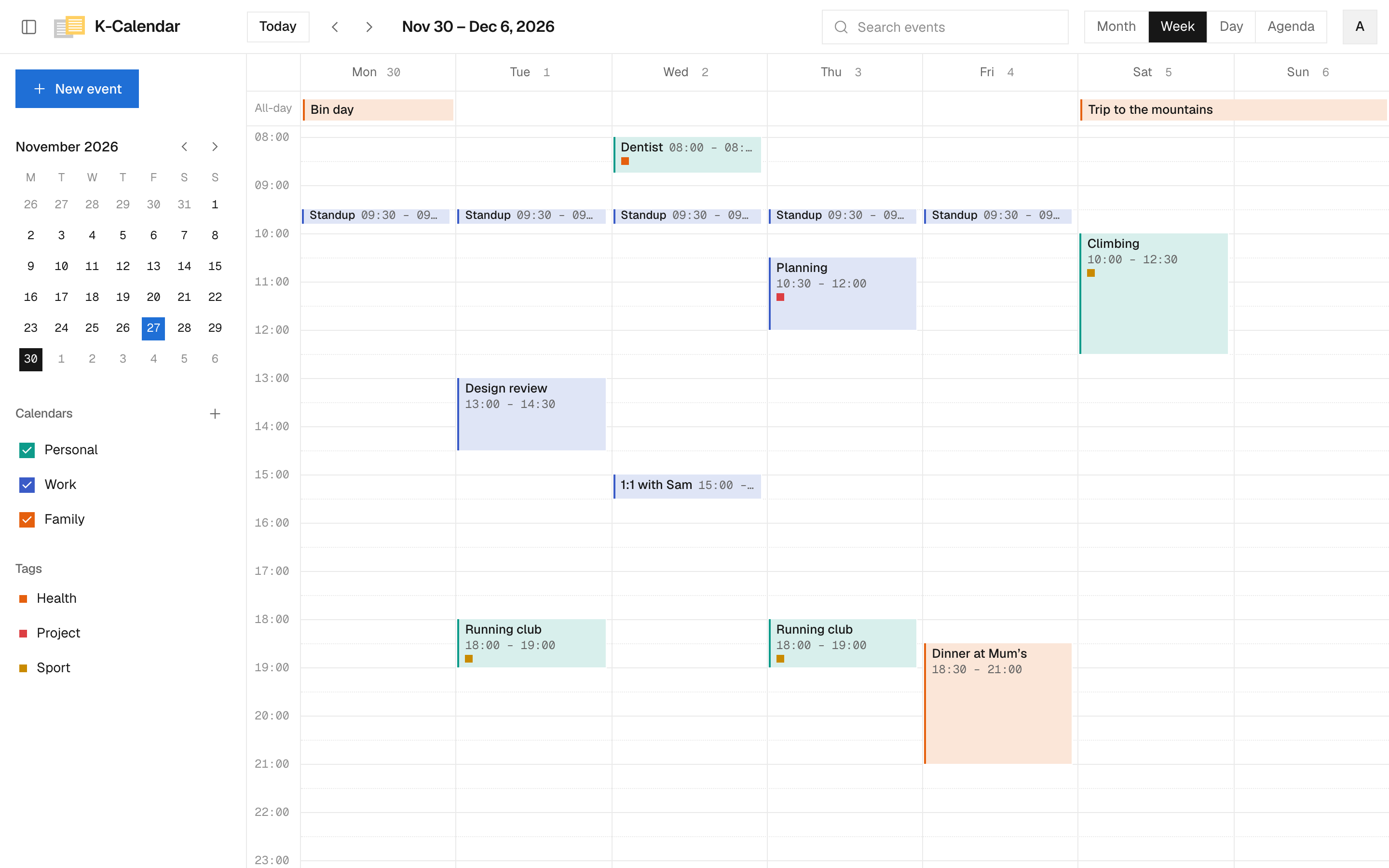
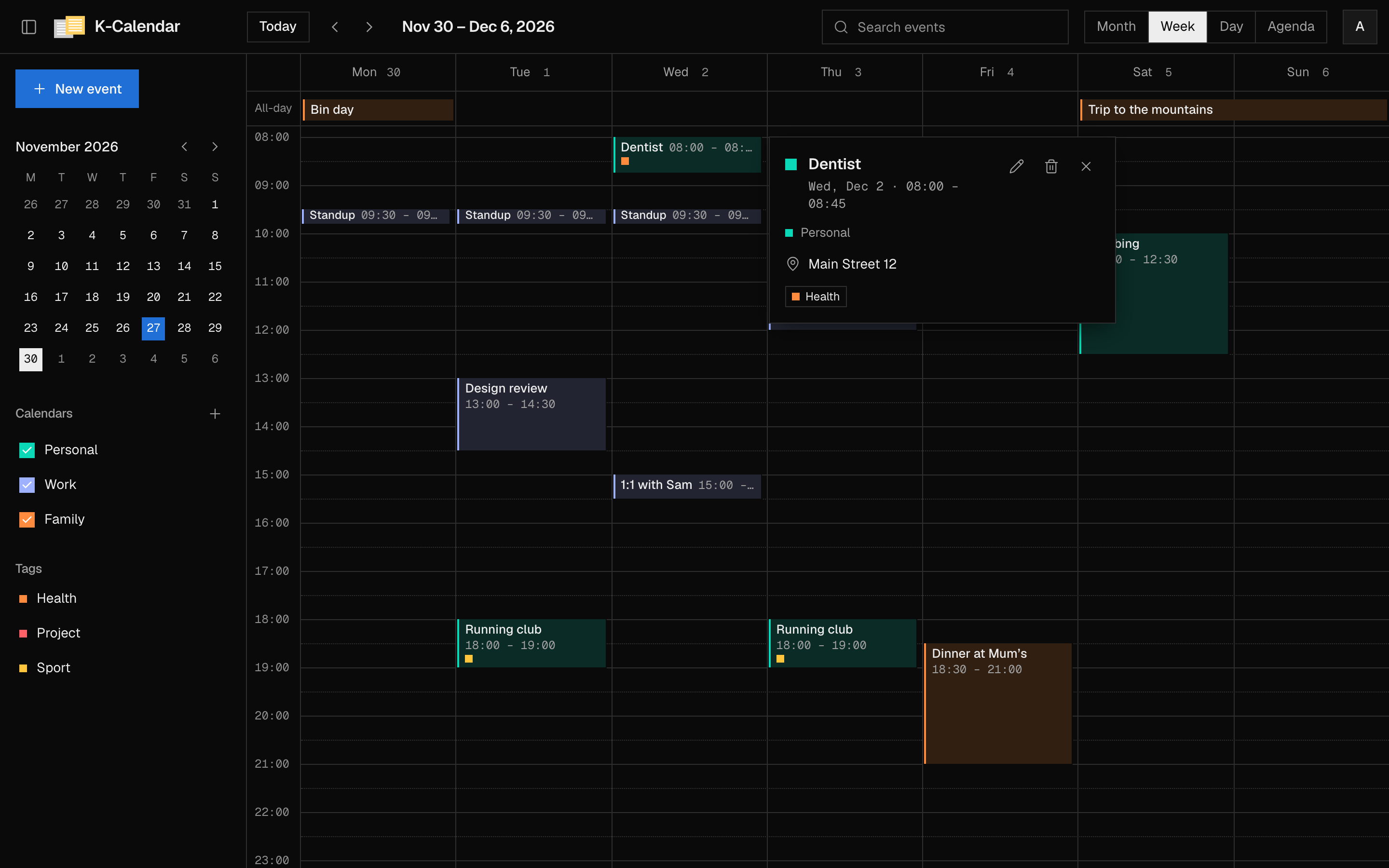
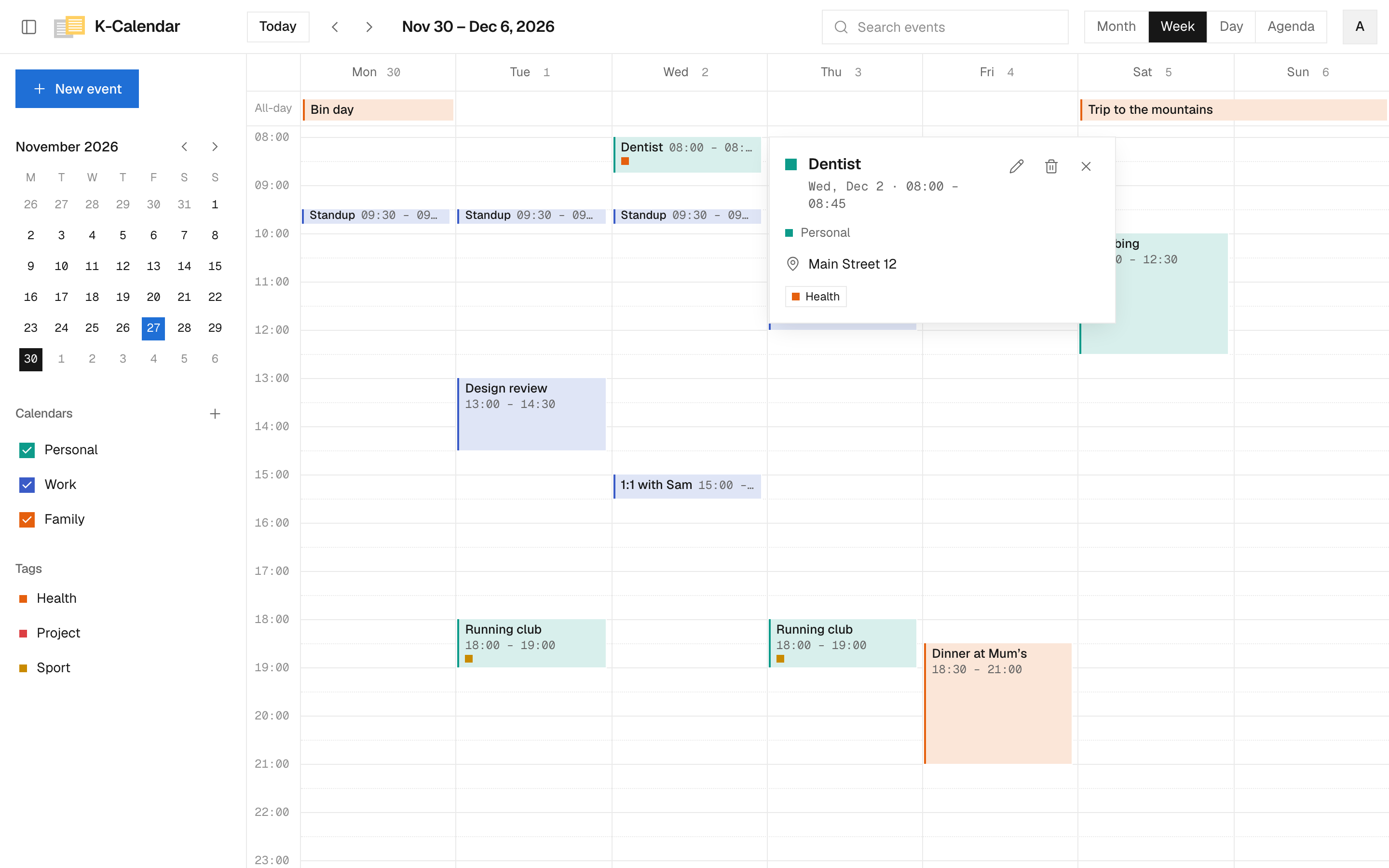
Four views, many calendars
Month, week, day and agenda. Several calendars with their own colours, each easy to hide, coloured tags across them, and search that ignores case and accents.
-
Events that repeat
From every weekday to the last Friday of every month. Change one occurrence, this and the following ones, or all of them.
-
Reminders that arrive
By push notification on your phone and computer, and by e-mail. Each is delivered once, even if the server restarts in between.
-
Time zones done right
Every event keeps its own zone, so a call abroad or a flight stays at the right hour when you travel or the clocks change.
-
Import, export, subscribe
Bring in an .ics file, export a calendar, give other apps a secret feed address, and subscribe to calendars such as public holidays.
-
For the whole household
Several accounts with private calendars, invite links, two-step verification, single sign-on through OIDC and personal API tokens.
Self-host it
You need a machine with Docker, a domain name and a reverse proxy with HTTPS, which browsers require for installing the app and for push notifications. The latest version is 0.3.0, released November 27, 2026.
-
Get the Compose file
Create a directory with the example file and a data directory. The container runs as user 1000, so that user owns it.
mkdir k-calendar && cd k-calendar curl -fsSLO https://raw.githubusercontent.com/K-cermak/K-Calendar/main/docker-compose.yml mkdir data && sudo chown 1000:1000 data -
Set your address
In docker-compose.yml, set APP_BASE_URL to the address people will use. It must match exactly.
environment: APP_BASE_URL: https://calendar.example.com -
Start it
Point your reverse proxy at port 8000, open the address and create the first account. It becomes the administrator.
docker compose up -d
Updating is one command; database changes run by themselves when the new version starts.
docker compose pull && docker compose up -dReverse proxy, e-mail, single sign-on, captcha and all settings are described in the guide on GitHub.
Questions
Is K-Calendar free?
Yes. It is free and open source under the MIT license, with no account on any service, no subscription and no limits other than the ones you set.
Is there a hosted version I can sign up for?
No. K-Calendar is made to run on your own server, so your plans stay with you. One small machine or a home server is enough.
How do reminders reach me?
As push notifications on every device where you turn them on, and by e-mail once an administrator enters a mail server in the administration. Each reminder is sent once, even across restarts.
How do I get it on my phone?
Open your address in the phone's browser and choose Add to Home Screen (Safari: Share › Add to Home Screen; Chrome: the install prompt or the menu). On an iPhone, push notifications work only for the app on the home screen.
Can I see my events in other calendar apps?
Yes, read-only. Every calendar has a secret feed address that other apps can subscribe to, and you can export a calendar as an .ics file. For scripts there is a REST API with personal tokens.
Does it work offline?
What was loaded stays readable without a connection, so you can check your plans on the go. Creating and changing events needs the server.
How do I back it up?
Stop the container and copy the data directory. It holds the SQLite database and the generated secret key, and nothing else is needed to restore the server.
What is left out?
On purpose: sharing calendars or events with other people, CalDAV and two-way sync with Google or Microsoft, attendees and invitations, and creating or changing events while offline.
Can I rely on it for important appointments?
Most of K-Calendar's code was written with an AI assistant and only partly reviewed by a human. It is fine for everyday plans, but it is not recommended for critical systems or anywhere lost or wrong data could cause harm. Keep backups.